Walk into almost any web design conversation today and someone will recommend a page builder. They are fast, they are visual, and they promise that anyone can build a beautiful website without writing a single line of code. So why does a studio like ours quietly refuse to use them? Because we have spent years cleaning up the damage they leave behind — and we would rather build something that lasts.
What “hand-coded” actually means
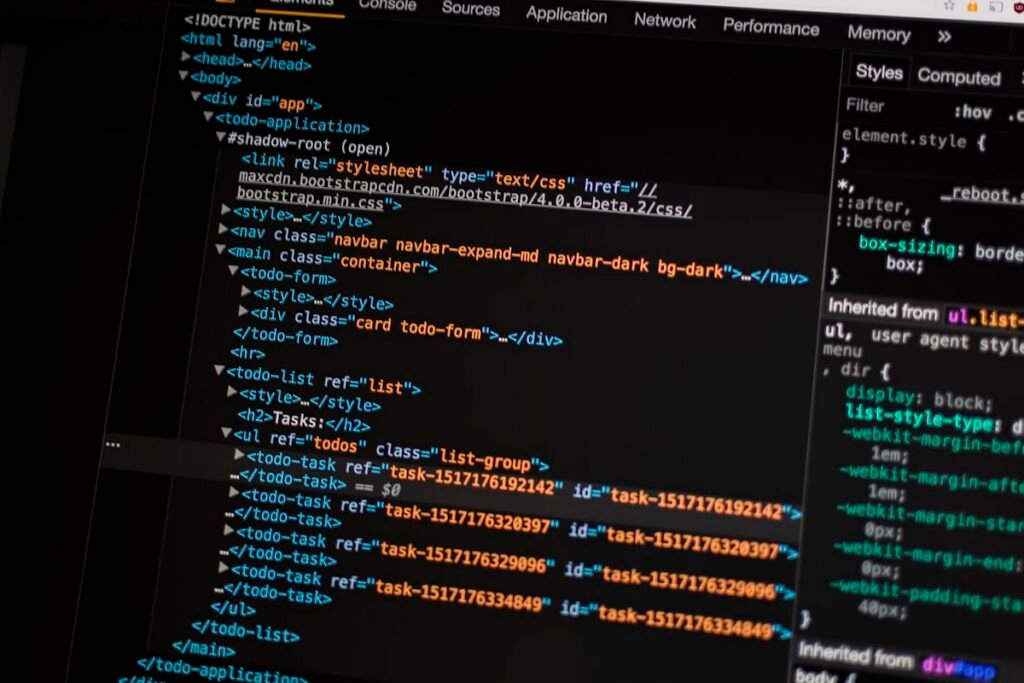
Hand-coding does not mean we reject every tool or reinvent the wheel on each project. It means the markup, styles and behavior of your site are written deliberately, by people who understand exactly what each line does. There is no hidden layer of generated code, no mystery scripts, and nothing on the page that does not need to be there.
The difference shows up the moment you look under the hood. A hand-coded page loads only the assets it requires. A builder-generated page typically ships a heavy framework, dozens of inline styles, and JavaScript for features you never use — all before your visitor sees a word of content. Multiply that across every page and every visit, and the cost becomes enormous.
The performance tax of page builders
Speed is not a vanity metric. It is the single most reliable predictor of whether a visitor stays or leaves. Page builders make speed almost impossible to control because they prioritize editing convenience over output quality.
- Bloated payloads. A typical builder homepage can be three to five times larger than its hand-coded equivalent.
- Render-blocking scripts. Builders load their own JavaScript on every page, delaying the moment your content becomes usable.
- Layout shift. Generated layouts often resize as they load, which Google penalizes and users find jarring.
When we rebuild a builder site by hand, the performance gains are rarely subtle. Load times routinely fall from several seconds to under one, and Lighthouse scores climb into the high nineties without any special effort. Those numbers are not for show — they translate directly into lower bounce rates and more inquiries.
Clean code is a form of respect — for the next developer, for the search engine, and most of all for the person trying to use your site.
Ownership and the lock-in problem
Page builders are commercial products. The pretty interface you build in is also a cage: your content is wrapped in proprietary shortcodes and structures that only that plugin understands. Deactivate it and your beautifully arranged page can collapse into a pile of unreadable tags.
Hand-coded sites have no such dependency. The HTML is standard, the CSS is standard, and the site will render correctly in any browser, on any host, for as long as the web exists. You own every file outright, and you are never one price increase or discontinued plugin away from a crisis.
Security by reduction
Every plugin you add is a door someone else built into your house. Most are fine; some are not; and the more you have, the more often you must check them all. The single biggest cause of hacked WordPress sites is out-of-date third-party code — exactly the kind that page builders pile on by the dozen.
A hand-coded site keeps its dependencies to an absolute minimum. Fewer moving parts means a smaller attack surface, fewer urgent updates, and far less chance that a vulnerability in a plugin you forgot about becomes your problem at the worst possible moment.
Accessibility and SEO come built in
Search engines and screen readers both rely on clean, semantic structure. When a heading is marked up as a heading and a button behaves like a button, everyone benefits — including the algorithms that decide where you rank. Builders frequently generate div-heavy soup that looks fine but reads as noise to a crawler or an assistive device.
Writing the markup ourselves means accessibility is not an afterthought bolted on at the end. It is the default. Every project ships with proper landmarks, logical heading order, descriptive alternative text, and keyboard support — the foundations of both inclusive design and durable SEO.
“But isn’t it slower to build?”
Honestly, for a throwaway brochure site, a builder can be quicker. But our clients are not building throwaway sites. They are building assets they intend to grow for years. Over that lifespan, the hand-coded approach is dramatically cheaper: there is less to break, less to update, and far less to undo when you want to change direction.
We also work from a refined component system, so we are never starting from a blank file. The result is the best of both worlds — the speed of a system with the quality of bespoke work, and none of the bloat that comes free with the convenience.
What this means for you as a client
You do not need to care about any of this in technical terms. What you should care about is the outcome: a site that loads instantly, ranks well, stays secure, works for everyone, and belongs entirely to you. Hand-coding is simply the most reliable way we know to deliver all five at once.
A note on longevity
There is a quieter benefit to hand-coding that only reveals itself with time: these sites age gracefully. Web standards are remarkably stable — the HTML and CSS we write today will still render correctly in a decade. Proprietary builders, by contrast, move fast and break things; a major version change can quietly alter how your pages look or behave, and support for older layouts eventually disappears.
When your site is built on standards rather than someone else’s product roadmap, you are insulated from that churn. Updates become a choice, not an emergency. We have hand-built sites that have run for years with nothing more than routine care, still loading instantly and still looking exactly as intended. That durability is not an accident — it is the direct result of keeping the foundation simple, standard and free of unnecessary dependencies. For a business that sees its website as a long-term asset rather than a disposable campaign, that longevity is worth more than any editing shortcut a builder can offer.
The bottom line
Page builders solve a real problem for people who need a website tonight and will not think about it again. That is not who we work with. If your website is a serious part of how your business earns trust and wins customers, it deserves a foundation that is fast, accessible, secure, fully owned, and built to last. That is what hand-coding delivers, and it is why we have never looked back.