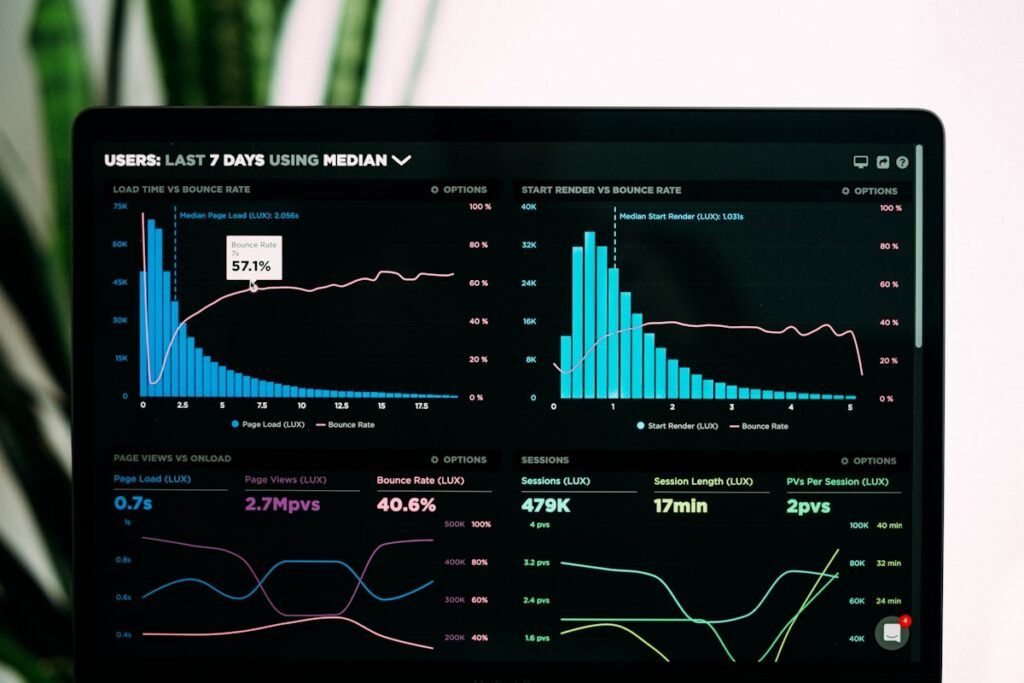
Most failing websites do not fail loudly. They do not crash or throw errors. They simply leak — losing a visitor here and an inquiry there, quietly, every single day, until the business owner wonders why a site that “looks fine” never seems to deliver. Here are the seven signs we look for first, and what each one is costing you.
1. It takes more than three seconds to load
Speed is the silent dealbreaker. More than half of mobile visitors abandon a page that takes longer than three seconds to load, and every additional second measurably reduces conversions. If your site feels sluggish to you on a good connection, imagine how it feels to a prospect on a train.
Slow sites are usually heavy sites: oversized images, bloated plugins, and render-blocking scripts. The fix is rarely glamorous, but the payoff — more visitors who actually stay — is immediate and easy to measure.
2. The first screen does not say what you do
You have roughly five seconds to answer three questions: what is this, is it for me, and what do I do next. If your homepage opens with a vague slogan instead of a clear value proposition, visitors will not work to decode it. They will leave and click the next result.
Test it ruthlessly: show your homepage to someone unfamiliar with your business for five seconds, then ask them what you do. If they cannot answer, neither can your visitors.
Confusion is the most expensive emotion on the web. A confused visitor never buys.
3. There is no obvious next step
A website without a clear call to action is a conversation with no ending. Every key page should make the next move obvious — book a call, request a quote, start a trial. If a visitor has to hunt for how to contact you, most will not bother.
- One primary action per page, stated plainly.
- Buttons that describe the outcome, not just “submit.”
- A way to get in touch visible without scrolling.
4. It looks wrong on a phone
The majority of your traffic is almost certainly mobile. If text overflows, buttons are too small to tap, or images spill off the screen, you are not losing a few customers — you are losing most of them. A site that merely “shrinks” on mobile is not the same as one designed for it.
Open your own site on your phone right now and try to complete your most important action with one thumb. If it is awkward for you, it is impossible for the impatient.
5. The design feels dated
Visitors form an opinion about your credibility in milliseconds, and design is the first signal they read. A tired, cluttered, or generic site quietly tells people your business is the same. Fair or not, an outdated website makes prospects assume your services are outdated too.
6. Nobody can find you
A beautiful site that does not appear in search is a billboard in a desert. If you are not ranking for the terms your customers actually type, the problem is usually structural: thin content, poor technical SEO, slow performance, or a site that search engines struggle to read. Traffic you never capture is the most invisible loss of all.
Good visibility is built, not bought. It comes from clean code, genuinely useful content, and the kind of fast, accessible experience that search engines now reward directly.
7. You cannot measure anything
If you do not have analytics in place, you are flying blind. You cannot fix what you cannot see, and you certainly cannot prove what is working. Without data, every decision about your most important marketing asset becomes a guess.
At minimum you should know how many people visit, where they come from, which pages they leave, and how many take the action that matters. That handful of numbers turns a mysterious website into a manageable one.
How to triage what you find
If several of these signs apply, do not panic and do not try to fix everything at once. Work in order of impact. Speed and clarity almost always come first, because they affect every single visitor on every single page. Mobile experience comes next, then search visibility, then polish. Fixing the foundations first means every later improvement compounds on a stronger base.
What a healthy site looks like
A healthy website loads in about a second, says what it does before you scroll, offers an obvious next step, feels effortless on a phone, looks current, appears for the searches that matter, and reports clearly on what is working. None of that requires magic — just intent, and a willingness to measure honestly.
The quiet killer: friction
Beyond the obvious seven, there is one subtler leak worth naming on its own, because it hides inside otherwise good sites: friction. Friction is every tiny moment of effort you ask of a visitor — a form with too many fields, a step that demands they create an account, a phone number buried three clicks deep, a download that wants their life story first.
Each individual obstacle seems reasonable. Together they quietly persuade people that dealing with you is hard work. The most effective conversion improvements we make are often not about adding anything at all — they are about removing. Cut a form from nine fields to three. Let people inquire without registering. Put the phone number where a thumb can reach it. Every barrier you remove is a customer you keep, and most businesses are amazed at how many they were losing to nothing more than mild inconvenience.
It also helps to revisit your site with fresh eyes every few months, ideally on a device and connection you would never normally use. Familiarity breeds blind spots: the owner who has seen a homepage a thousand times stops noticing the very friction that sends first-time visitors away. A deliberate, regular audit keeps the small leaks from quietly becoming a flood again.
The bottom line
Any one of these signs is a slow leak. Together, they are a flood. The encouraging news is that every one of them is fixable, often without a full rebuild. Start by being honest about which apply to you — then fix them in order of impact. Your website should be your hardest-working salesperson; if it is quietly losing customers, it is time to put it back to work.