It is 11:45 PM on a Tuesday. Someone is sitting in a lit kitchen, looking at a court notice, a breathalyzer refusal citation, or a draft of a severance agreement. Their chest is tight. They open Google, type a search, and tap the first organic result.
Three seconds later, they back out. They do not leave because your attorneys went to the wrong law school or because your firm lacks trial experience. They leave because your homepage looks like a brochure for an accounting software vendor.
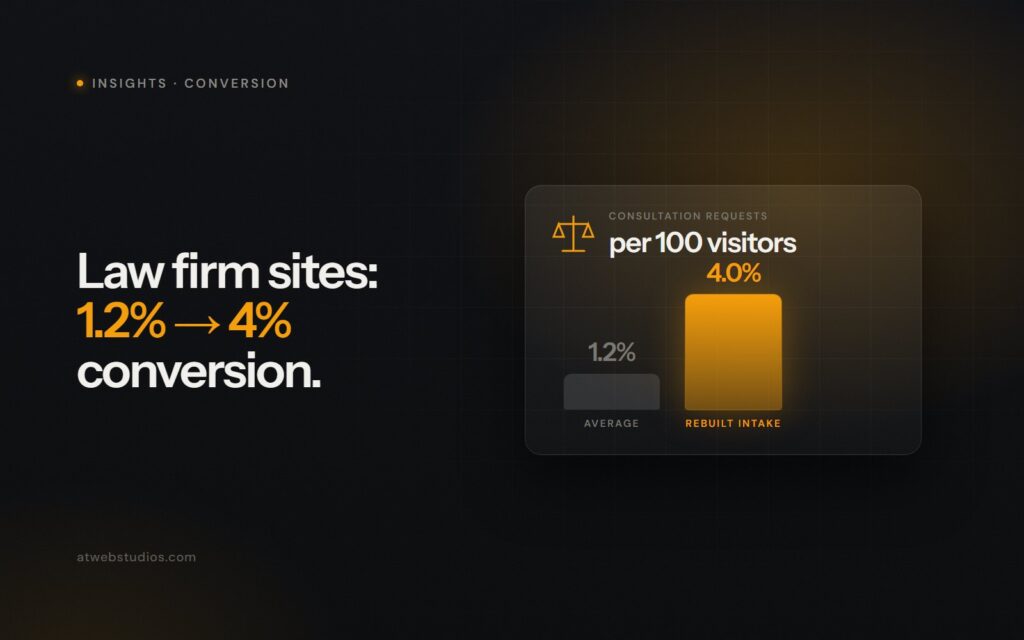
Across the legal industry, the average law firm website conversion rate hovers near 1.2%. Out of every one hundred people who reach your site, ninety-nine leave without calling, filling out a form, or booking a consultation. High-performing legal sites, by contrast, pull roughly 4.1% of their traffic into active intake channels. That gap is not a margin of error. It is the difference between an idle associate and a booked calendar.
Prospective legal clients operate under extreme emotional stress
Most commercial web design assumes a calm user. Software buyers compare feature tables over an afternoon coffee. Corporate buyers download whitepapers to review during a quarterly planning cycle.
A legal client rarely buys in a calm state. They arrive on your site while facing financial ruin, criminal prosecution, painful family disputes, or severe physical injury. When a person is frightened, their brain suppresses complex decision-making and prioritizes fast, unambiguous reassurance.
If your site forces a panicked visitor to decipher corporate jargon or hunt through a dropdown menu of thirty practice areas, you lose them. They will hit the back button and call the firm whose homepage speaks to their exact situation within two seconds.
Specific scenario clarity beats broad practice area lists
Walk through the homepage of a typical regional practice. You will usually see a stock photograph of a gavel or a city skyline, followed by a bulleted list: Commercial Litigation, Family Law, Estate Planning, Personal Injury.
This layout tells a prospect nothing about whether you can solve their specific problem. A business owner facing a shareholder buyout dispute does not think, “I need Commercial Litigation.” They think, “My partner is pushing me out of my company.”
High-converting law firm sites replace abstract practice categories with concrete, scenario-based headlines. They spell out the exact conflict, the immediate risk, and the next physical step.
People looking for legal counsel do not want to read about your firm’s history; they want to know what happens to them tomorrow morning.
When you frame your expertise around actual client outcomes rather than legal taxonomy, trust moves instantly. The prospect stops shopping and starts listening.
Over-complicated intake forms destroy qualified lead volume
Once a prospect decides your firm might be the right fit, they reach your intake point. This is where most law firm sites throw up friction.
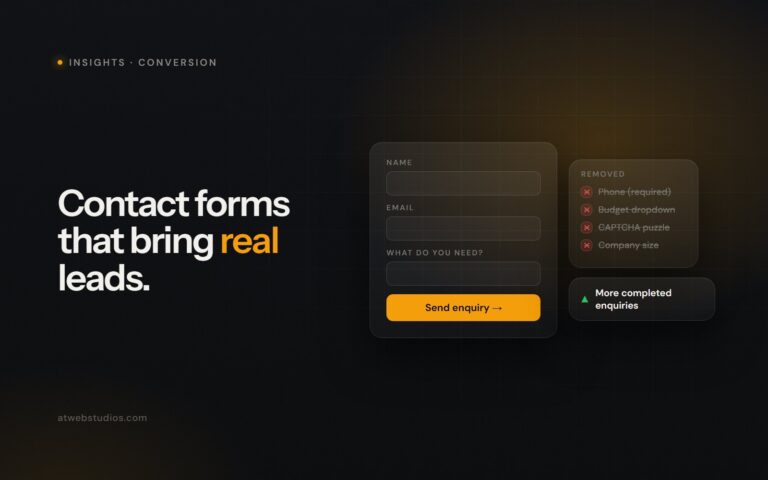
A form demanding fourteen fields—including social security numbers, insurance policy details, and a narrative box—feels like an interrogation. To a stressed visitor, every required field is a reason to abandon the process.
Intake triage requires a multi-stage approach. Your initial form should collect only what your staff needs to clear conflicts and make a return phone call: name, contact method, urgency level, and a brief description of the issue.
You can gather case specifics during the follow-up call or through an automated post-submission sequence. By separating intake triage from case discovery, you eliminate the cognitive burden that drives form abandonment.
Technical speed dictates trust before the page finishes rendering
Legal services carry high financial and personal stakes. Because of this, visitors judge your firm’s competence through subtle technical cues long before they read your text.
If your site takes four seconds to load over a mobile connection, a user subconsciously projects that lag onto your legal operations. Slow load times, shifting layouts, and broken mobile buttons communicate a lack of care.
Mass-market page builders render hundreds of unnecessary script files before showing a single headline. That latency damages both user patience and search performance. When we construct custom web development projects for professional practices, we cut server response times down to milliseconds, ensuring the site renders instantly even on a weak cellular connection.
When your site loads instantly, it projects authority, efficiency, and respect for the user’s time.
How to fix your law firm website conversion rate
Tripling your conversion numbers does not require a complete rewrite of your legal positioning. It requires systematically removing friction from the user journey.
Here are the core adjustments that move a law firm site from the 1.2% industry average toward the 4% benchmark:
- Match the headline to the user’s panic. Replace generic slogans with direct statements that state who you help and what crisis you resolve.
- Strip down the initial contact form. Limit initial intake to four essential fields so a client can reach out in under thirty seconds.
- Place phone numbers in sticky headers on mobile. Most urgent legal searches happen on phones, where a single tap to dial is critical.
- Show real attorney faces, not stock imagery. Stock photos signal an impersonal template; genuine photos build personal trust immediately.
- Optimize page load speeds under two seconds. Technical responsiveness directly impacts visitor patience and conversion behavior.
To execute these changes effectively, you need a site built around clear user psychology rather than heavy page-builder templates. Our web design studio builds focused, hand-coded platforms tailored specifically for professional service firms that need higher lead performance.
What managing partners should do next
Start by opening your firm’s website on your mobile phone over a cellular network—not your office Wi-Fi. Try to submit an inquiry using one hand while walking across a room.
Note where you stumble. Measure how long the page takes to load, count how many fields the contact form requires, and evaluate whether your practice headers clearly state who you serve.
Once you identify where prospective clients encounter friction, prioritize those fixes. Eliminating two unnecessary form fields and clarifying your primary practice headlines can immediately double your monthly inquiry volume without spending another dollar on advertising.
Related reading
Frequently asked questions
What is a good conversion rate for a law firm website?
The average law firm website converts around 1.2 percent of its traffic into active inquiries. High-performing legal websites achieve a conversion rate of roughly 4.1 percent.
Why do prospective legal clients quickly leave a law firm homepage?
Most prospective clients arrive on a legal site under severe stress and leave if forced to decipher corporate jargon or broad lists of practice areas. They seek immediate reassurance and clear scenarios that match their specific situation within seconds.
How can a law firm improve its website intake form conversion rate?
Law firms should simplify initial intake forms to collect only essential information, such as contact details, urgency level, and a brief issue description. Requesting detailed narratives or sensitive data upfront creates friction that drives visitors to abandon the form.
How does website load speed affect a law firm's client conversion rate?
Slow load times cause visitors to subconsciously question a law firm's operational competence before reading any text. When a site takes several seconds to load over mobile connections, visitors often leave before the page finishes rendering.